

The latest BIS (Bank for International Settlements) run a survey of over 50 central banks every three years. I’m not normally that surprised by their figures, but this year seems to mark a milestone as they found that the worldwide movement of currencies had risen to almost $10 trillion a day! *
Here are the key highlights of the report:
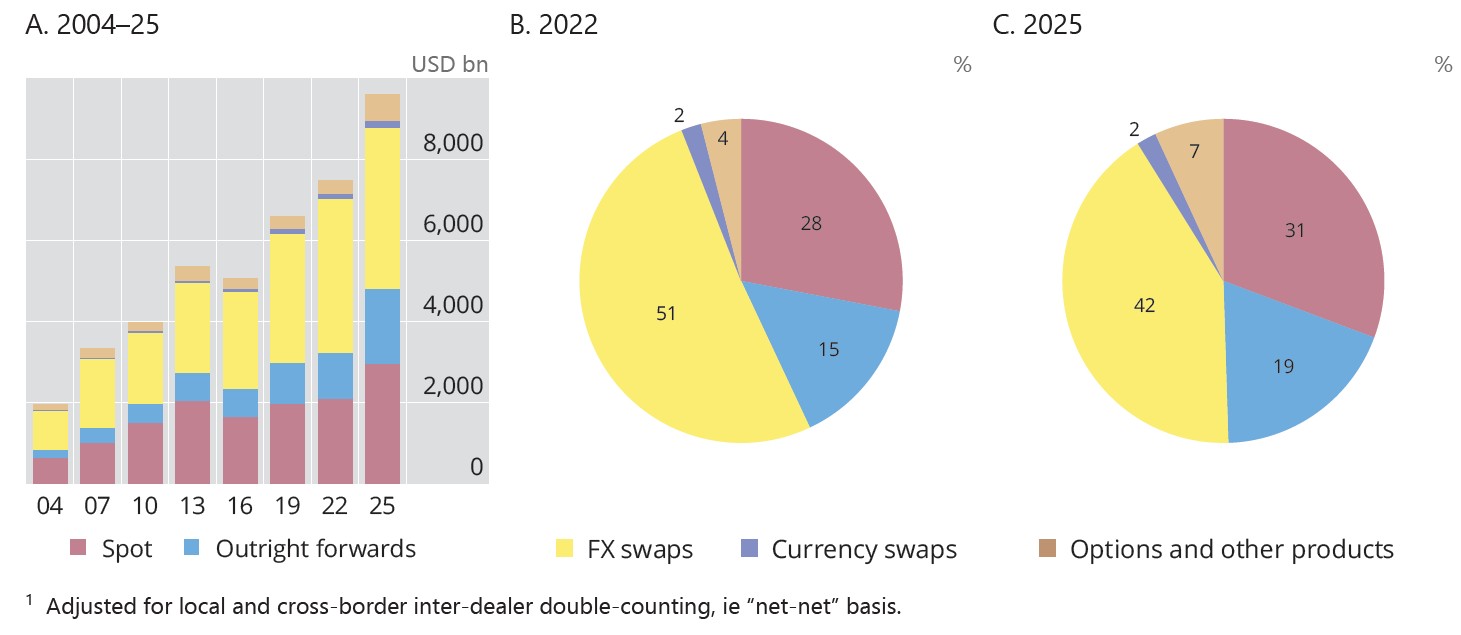
- Trading in OTC FX** markets reached $9. 6 trillion per day in April 2025, up 28% from $7. 5 trillion three years earlier.
- Turnover of FX spot and outright forwards*** was 42% and 60% higher, respectively. Their shares in global turnover thus increased, from 28% and 15%, to 31% and 19%, respectively. Turnover of FX options more than doubled. Turnover of FX swaps grew modestly, resulting in a drop in their share to 42% (from 51% in 2022).
- The US dollar continued to dominate global FX markets, being on one side of 89. 2% of all trades, up from 88. 4% in 2022. The share of the euro fell to 28. 9% (from 30. 6%) and that of the Japanese yen was virtually unchanged at 16. 8%. The share of sterling declined to 10. 2% (from 12. 9%). The shares of the Chinese renminbi and the Swiss franc rose to 8. 5% and 6. 4%, respectively.
- Inter-dealer trading accounted for 46% of global turnover (almost unchanged from 47% in 2022). The share of trading with “other financial institutions” was 50% (up from 47%). At $4. 8 trillion, turnover with other financial institutions was 35% higher than in 2022, mostly driven by 72% higher trading of outright forwards and a 50% increase in spot transactions with this counterparty group.
- Sales desks in the top four jurisdictions – the United Kingdom, the United States, Singapore and Hong Kong SAR – accounted for 75% of total FX trading (“net-gross” basis). Singapore gained market share, reaching 11. 8% of the total (up from 9. 5% in 2022).
I really took note of one of those headlines which is that the US dollar is involved in nearly 90% of all trades. We can talk about dedollarisation, but if the world is moving $10 trillion a day, of which $9 trillion are US dollar denominated, then I don’t see that happening for a long time.
You can download or read the full report here and, if you have two minutes, the summary highlights video from the BIS is worth a view.
* Note that the figures relate to April 2025, when the survey was made, and so I would expect that right now $10 trillion or more is moving around the world of which $9 trillion is backed by the US dollar
** OTC over-the-counter FX, or Foreign Exchange, refers to forex trading that does not happen on a formal exchange, but instead directly between two parties, such as a client and a bank or dealer, through a network. This allows for customised contracts to meet specific needs but comes with less transparency and regulation than exchange-traded instruments, creating potential risks. This system is run by a few hundred traders worldwide, who represent the whole currency system of the world, according to LoopFX,
Blair Hawthorne, founder of LoopFX, made it clear to me with this quote:
“What’s striking isn’t just that FX turnover hit $9. 6 trillion a day - it’s who is behind that growth. Since the 2022 BIS survey, overall volumes are up about 28. 5%. Dealer-to-dealer trading rose by roughly 25% - from about $3. 50 trillion to $4. 37 trillion per day - but institutional investors expanded their activity by nearly 60%, climbing from around $820 billion to $1. 3 trillion per day. In short, the buy-side has been the fastest-growing client segment in global FX. ”
*** A spot forward (or spot transaction) is the immediate exchange of currencies at the current market rate, typically settling within two business days. In contrast, an outright forward is a contract to exchange currencies at a future, predetermined date and at a specific, agreed-upon rate, which accounts for interest rate differentials between the currencies. Spot transactions are for immediate needs, while outright forwards are used for hedging future currency risk or locking in a rate for a future business obligation.