


Likely of little or no surprise to advisors, retail investors are enthusiastic about artificial intelligence (AI) and this extends beyond simply allocating capital to “hot” AI stocks or funds.
In many cases, advisors aren’t custodying all of a client’s assets. Whether it’s a high-net-worth customer or a younger client just starting out, they’re likely to have discretionary accounts, implying the advisor isn’t their only source of advice or information. It’s a safe bet that AI is informing some of their investing decisions that are outside of the advisor’s purview.
Heed this data point: a new Investing. com survey confirms 62% of retails investors are somewhere in the range of AI devotees to, at a minimum, tinkering with the technology as part of their personal investing process. Another 21% are considering using AI for investment advice or analysis at some point.
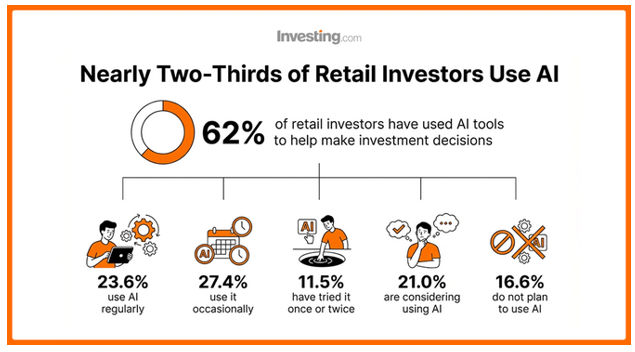
(Image Courtesy: Investing. com)
As the image confirms, there’s a better than eight in 10 chance that clients are embracing AI in some form of fashion when it comes to their capital that’s outside the advisor’s jurisdiction.
The AI Conversation Is Worth It
Advisors aren’t babysitters and “policing” what clients do with the money the advisor isn’t managing is a bridge too far, but it is worth getting a handle on how clients are using AI for investing purposes.
"Arguably, there are only a handful of industries in which AI has proven as disruptive as quickly as it has in the financial industry," notes Thomas Monteiro, senior analyst at Investing. com. "This is even more pronounced for retail investors, where companies can now offer access to all types of financial-grade tools at a fraction of what they cost just a couple of years ago. As these models evolve and become increasingly relevant, usage is likely to continue growing—even among those already interacting with some type of AI investment assistant. "
Regarding the “how” of clients extracurricular AI usage, Investing. com notes 53. 5% use AI chatbots, such as ChatGPT or Grok, for investing research purposes. Another 30. 6% use AI to screen stocks. Thirty-five percent of respondents say they use the technology to better synthesize market news and nearly the same percentage said they tap AI for trading ideas.
From those data points, it can be inferred that AI is often a point of emphasis for active retailers. Add to that, just 6. 4% told Investing. com they’re using AI for portfolio construction. That may be a sign they prefer to leave that heavy lifting to human advisors.
Clients Are In Trust But Verify Mode
In what may be another positive sign for the future of the wealth management industry, in human form, 53. 5% of those queried told Investing. com they trust the investing information they get from AI, but they verify it elsewhere.
An even more interesting tidbit is that 23% of respondents have either limited or no trust of AI’s investment advice. On the other hand, just 23. 6% are in the “mostly” or “completely” trust camps.
Bottom line: Clients clearly like technology and having investing ideas at their fingertips, but it appears they like trustworthy human sources of investing advice even more.