


It’s been a long, often slow-moving road, but women have made strides in the financial services industry, including in the wealth management.
However, there’s still plenty of work to be done. Part II of AdvizorPro’s 2025 Advisor Demographics & Team Structures Series confirms as much. Getting straight to the date, the study confirms just 24. 2% of advisors are women, but that’s actually an improvement over the levels seen in prior years.
“Gender representation in the advisor profession remains uneven, with fewer than one in four advisors identifying as female,” according to the research firm. “However, this figure reflects progress over the past decade, particularly within team-based firms, larger institutions, and firms with formal recruiting or mentorship programs. ”
While the wealth management industry is facing challenges in terms of attracting and retaining talent, it’s reasonable to expect the percentage of women in client-facing money management roles will continue rising for multiple reasons. Those include increasing wealth among women and a desire of some to work with female advisors.
Firm Structure Implications
As noted above, 24. 2% of advisors identify as female, but that’s an industry average, meaning the percentages vary by firm structure. As AdvizorPro points out, 30. 6% of female advisors work at wirehouse firms and 28% work at broker-dealers.
“RIAs, while the fastest-growing channel overall, continue to lag in gender diversity. This may reflect historical firm ownership patterns, the slower adoption of recruiting infrastructure in smaller firms, or the challenges of entering more entrepreneurial models without formal support,” notes AdvizorPro.
Broker-dealers and wirehouses having higher percentages of female advisors isn’t surprising and it’s not necessarily a knock on hybrid and independent firms. The reality is bigger branded entities have the resources needed to execute demographic-focused hiring and training.
“Female advisor participation is highest in organizations with established hiring and development processes. Smaller or independent RIAs, while growing rapidly, have not yet built those same structural supports,” adds AdvizorPro.
Geography Matters, Too
Upon learning that geography plays a role in female advisor hiring patterns, it’d be reasonable to expect one would assume states like California, Illinois and New York would lead the way in terms of percentage of female advisors. That’s not the case as highlighted in the AdvizorPro table below.
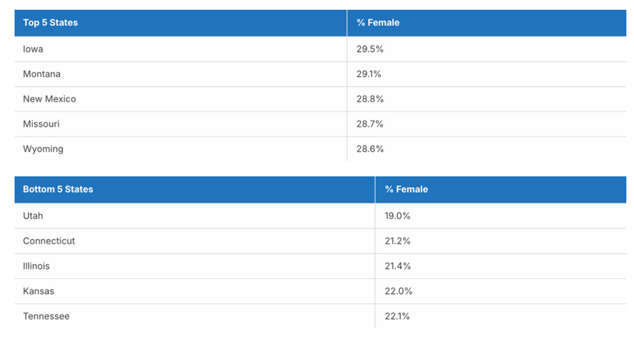
“These differences likely reflect a mix of factors, such as local firm composition, dominant channel types (e. g. , bank-affiliated vs. independent), and the presence—or absence—of advisor training pipelines. In some higher-ranking states, a larger proportion of advisors work within structured environments or regional institutions where collaborative team dynamics may support broader participation,” according to the research firm.
Beyond geography, there are some encouraging data points regarding women in leadership/ownership roles in the wealth management arena.
“While women represent just 18. 0% of advisors in the RIA channel overall, the proportion of firms with female ownership is meaningfully higher at 23. 5% suggesting that independent firms may offer more accessible paths to leadership, particularly for advisors pursuing entrepreneurial models or launching their own practices,” concludes AdvizorPro.