


It’s increasingly said that “rich” and “wealthy” are two distinctly different concepts. “Rich” is a financial state while it’s possible, depending one’s perspective, to feel wealthy without being rich. Add comfort into the equation and it makes for interesting, important conversation between advisors and clients.
While wealth has grown to encompass esoteric concepts, there’s no denying that there is a financial component to it and that’s never going to change. Likewise, being comfortable requires a decent amount of financial resources, though comfort can be attained without becoming a millionaire. What is changing, however, is the amount of financial resources people think they need to qualify as wealthy/comfortable.
Consider the findings in Charles Schwab’s 2025 Modern Wealth Survey. It now takes $839,000 to feel financially comfortable. That’s up from $778,000 in the 2024 edition of the poll, but well below the $1. 3 million seen the year prior.
Still, $839,000 is not a small amount. Round it up to $840,000 and a client that comes in the door with $50,000 in assets needs to save $3,000 a month for 12 years and one month, assuming average annual returns of 8%, to get to $840,000.
Getting to Wealthy Takes Work
From 2021 to 2025, respondents to the Schwab survey said the dollar figure needed to be considered wealthy ranged from $1. 9 million (2021) to $2. 5 million (2024). It came in at $2. 3 million this year, representing some sort of progress, but the unsurprising fact is there’s a significant financial component involved with being wealthy.
“While the dollar amount to be considered wealthy has remained relatively consistent over the last several years, Americans still say that the bar to achieve monetary wealth feels like it is increasing,” according to Schwab. “Nearly two-thirds (63%) of survey respondents say it feels like it takes more money to be wealthy today when compared with last year, and they cite the impact of inflation (73%), a worsened economy (62%), and higher taxes (48%) as the top reasons. Forty-three percent of survey respondents cite higher interest rates and the impact on borrowing as a reason it takes more money to achieve wealth. ”
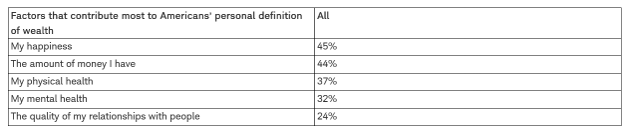
Obviously, advisors are assets to clients on their roads to financial accumulation and wealth-building, but advisors are also relevant because they can help shape clients’ views of wealth beyond finances. That’s an important exercise because the harsh reality is many investors and workers will not amass $2. 3 million in assets. As confirmed by the Schwab table below, there various lenses through which to view wealth.
Some Good News About Younger Clients
Speaking of perceptions, some advisors ought to alter their views about millennials and Gen Z because the Schwab survey indicates those “youngsters” are organized when it comes to their finances and see the value in planning, implying they also see value in working with advisors. They’re also pragmatic when it comes to their views on wealth.
“Consistently with previous years of the study, Gen Z sets the lowest threshold for what it takes to be financially comfortable,” adds Schwab. “Younger people are also more optimistic they’re on the right track – 43% of Gen Z respondents and 42% of Millennials believe they’ll achieve wealth (or already have), versus 33% of Gen X and 20% of Boomers who say the same. ”
Further solidifying the importance of advisors and dispelling the notion that they’ll be displaced by artificial intelligence (AI) is the point that a quarter of the respondents to the Schwab survey acknowledged they may need to make lifestyle changes to reach financial comfort or to become wealthy. Advisors can assist with those alterations.