


Advisors aren’t psychics, but there are ways for them to get inside the minds of retails investors, also known as clients.
Better connecting with these market participants is a worthwhile endeavor because according to a recent State Street Investment Management survey, nearly 60% are self-directed investors. Alone, that’s a compelling reason to get a handle on the priorities’ of retail investors. No, not all of those investors will be converted to client, but 60% is a large number and with a few prospect-to-client conversions here and there, practice growth could be substantial.
Fortunately, there’s an easy place when getting inside the minds of retail investors. The State Street survey confirms this cohort is increasingly focused on retirement.
“Retirement planning is top of mind for most retail investors. Two-thirds of investors (67%) say one of their top five financial goals is having enough money to last through retirement,” notes the asset manager. “And nearly half of investors want to maintain their lifestyle in retirement (48%) and be prepared for healthcare costs (46%)—all signs that long-term security is paramount.”
Retail Investors Surprisingly Risk-Averse
For all the talk about younger retail investors embracing meme coins and meme stocks and the increasing gamification of investing, many retail investors are surprisingly risk-averse. That despite acknowledgement from many that equities are critical pieces in the long-term wealth-building puzzle.
(Image: State Street Investment Management)
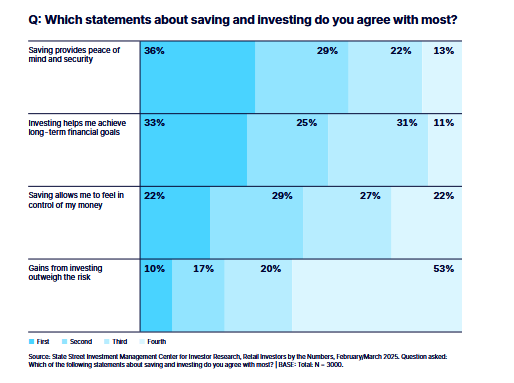
At least one inference can be made from the table above: The retail crowd recognizes the value of investing, but many are too afraid of the risks and they’d prefer to be in cash. It’s not a stretch to assume many investors holding that sentiment are NOT working with advisors.
“One-third most strongly agree that investing helps them achieve long-term goals—yet only 10% most strongly agree that gains from investing outweigh the risks,” adds State Street. “Translation: investors recognize the purpose of investing, but not necessarily the payoff. “Even when investors have money left over each month, they’re more likely to tuck it into savings (56%) than put it into the market (44%).”
Comfortable, Confident, Content
Advisors looking to make headway with retail prospects, particularly those in the low risk tolerance camp, should consider the three “C’s” of comfortable, confident and content. In theory, those feelings are related. After all, if an investor feels comfortable, it’s plausible to assume they’re also confident or, at the very least, content. That’s not the case with many retail investors.
State Street notes that 61% of those surveyed are satisfied with their current portfolios and just 55% are confident in calling their own investment shots. Those aren’t high percentages given the subject matter and they’re low enough to imply scores of retail investors would derive significant benefit from working with advisors. For the investors out there on the fence about working with an advisor, consider the following.
“If your portfolio feels ‘just okay,’ clarity may be what's missing. Strengthen confidence by closing gaps in your understanding of risk, allocation, or performance drivers. And consider if you’d benefit from professional guidance,” concludes State Street. “Emotions and biases—like loss aversion and recency bias—can quietly steer decision making. You can’t get rid of them completely, but you can recognize them and pause before reacting.”