


In a normal week, tomorrow would be a market highlight. The combination of a PPI report in the morning and an FOMC meeting in the afternoon should have investors anticipating a pair of potentially market-moving events. Instead, both seem like afterthoughts amidst an ever-changing global scenario. Nonetheless, both can offer important insights into the state of the economy, and hence impact market psychology, even if the risks might be one-tailed.
First up tomorrow is the PPI report. Consensus expectations for the headline, core, and ex-food, energy and trade all show rises of 0. 3% in February on a month-over-month basis. That would put the first two below last month’s readings of 0. 5% and 0. 8%, while the third would match January’s level. Even at 0. 3%, all would annualize, whether on a one-, three-, or four-month basis, to an inflation reading well above the Fed’s 2% target, but a bunch of as-expected reports would show inflation moving in the desired direction.
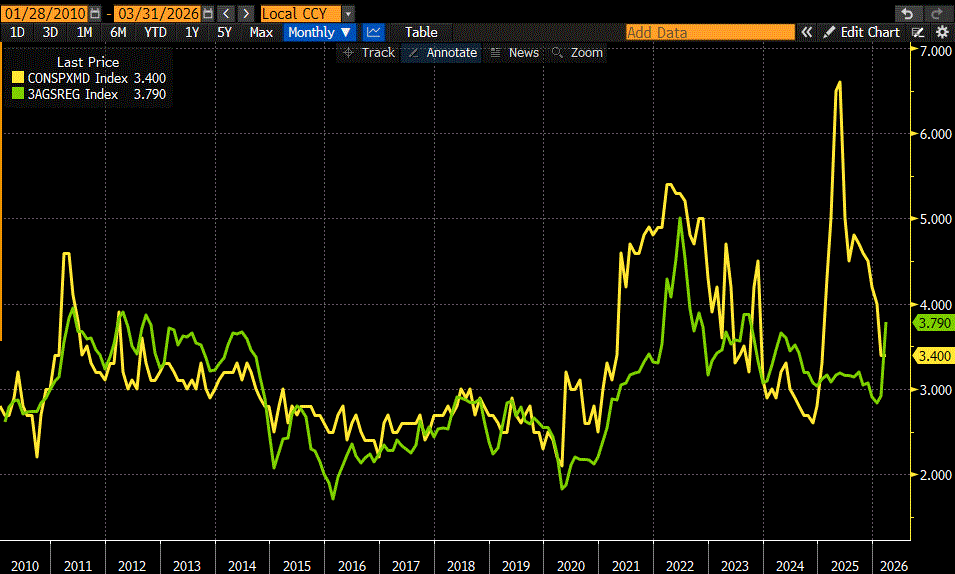
Yet even if the reports come in as expected, or even better, would that meaningfully change the FOMC’s outlook on the prospects for future inflation? Presumably not. A data-dependent central banker would be remiss to fixate on backwards looking data when there is a clear risk of higher energy prices creating price pressures throughout the economy. Sure, we know that inflation measures that exclude volatile food and energy components from the mix are considered preferable, but a sustained boost to energy prices spills into other prices and inflationary expectations. All manners of products use oil-related products for their manufacture and/or shipping, and there has historically been a close relationship between gasoline prices and 1-Year University of Michigan Consumer Inflation Expectations. As the chart below shows, that relationship broke last year as consumers feared the effects of tariffs, but it had finally returned to relative normalcy. It would be naïve to think that the sharp jump in prices at the pump will show no impact upon inflation expectations when the next Michigan data arrives on March 27th.
Since 2010, UMich 1-Year Inflation Expectations (yellow), National Average Regular Unleaded Gasoline Prices (green)
Source: Bloomberg
That points out the one-tailed nature of tomorrow’s PPI report. A better-than-expected report might be easily dismissed as poorly reflecting current conditions. Meanwhile, a worse-than-expected report could cause investors to think, “If it was this bad before the Iran situation, how much worse will it be afterwards? ”
Something similar is in effect for the FOMC. Fed Funds futures and prediction markets agree in assigning virtually no probability to a rate change after tomorrow’s meeting. A lame duck Chair and a lack of economic clarity make that a very safe assumption. Although those sources now price in at least one rate cut by December, as recently as last week they were anticipating a cut no earlier than the first or second quarter of 2027. Some of the uncertainty may have cleared up on Friday afternoon after a Federal Judge quashed grand jury subpoenas of the Fed and Chair Powell. A cessation of that legal activity would allow NC Senator Tillis to remove his threatened hold on the nomination of Kevin Warsh, but yesterday’s Justice Department motion for reconsideration could further delay the process.
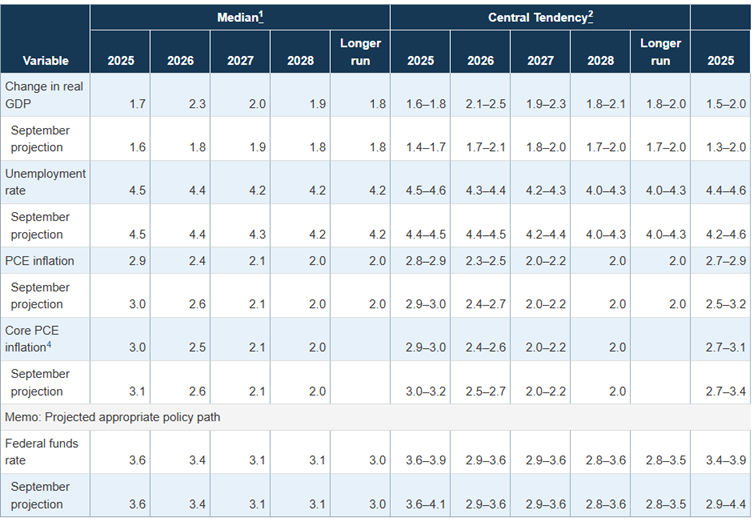
Instead, investors are likely to pay their closest attention to the Summary of Economic Projections, aka “Dot Plot”, that is due for release tomorrow. December’s SEP showed a median expectation for a 3. 4% Fed Funds rate at the end of 2026, implying two cuts during the year. Bearing in mind that until very recently markets had consistently been more aggressive in predicting cuts than the FOMC, it will be fascinating to see if the FOMC members now match market expectations for fewer cuts. It will also be useful to note if the committee foresees changes in their GDP, inflation, and Unemployment Rate projections. Unlike with PPI, this could spur a move in either direction; the FOMC meeting could surprise positively if the Fed reaffirms the notion of cuts in 2026.
December Summary of Economic Projections
Source: Federal Reserve
Source: Interactive Brokers