


Social Security has always mainly been a transfer system, in which most or all workers’ payroll taxes immediately pay for benefits to retirees. The same is true for Medicare, though it also relies significantly on income taxes, which workers largely pay. With the Social Security and Medicare trust funds now holding close to zero assets, it’s clear that any prior buildup of trust fund assets, such as during the peak working years of the baby boomers, was temporary and very small relative to the unfunded promises made.
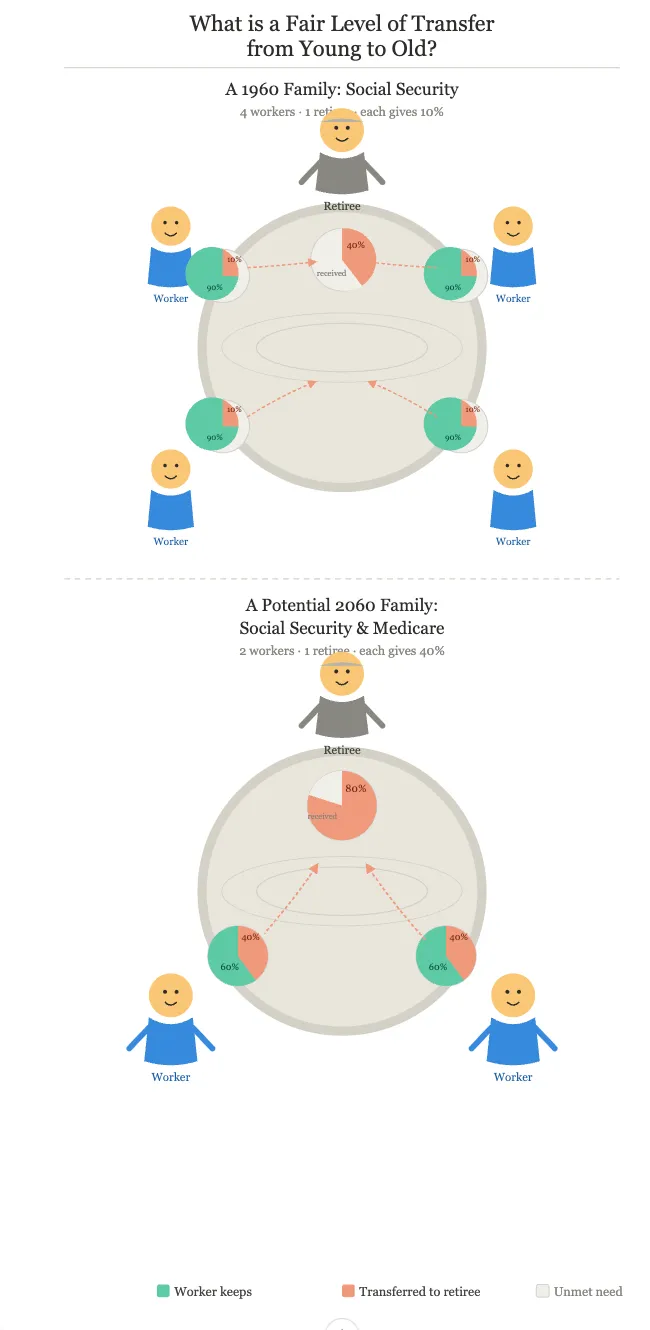
Today, both systems face a significant shortfall in revenues needed to pay current beneficiaries at existing rates, not to mention future beneficiaries at higher rates. These shortfalls, which will increase over the coming decades, mainly stem from how Congress has scheduled these systems to take an ever-larger share of the nation’s income—almost indefinitely. Now, on the verge of a crisis, everyone agrees that reform is necessary. However, no reform proposal for Social Security (much less for Medicare) has addressed how large this transfer from younger to older generations should be.
Consider: for the first time in the nation’s history and, with rare exception, in the history of civilization,
- People under age 65 are much more likely than older individuals to be in poverty or in lower-income groups.
- The government considers people ‘old” (eligible for what it calls “Old Age Insurance” under Social Security) at age 62, when a man now has an average life expectancy of over twenty years, a woman about a quarter century, and the longer-living of a couple about three decades. As healthcare continues improving, those numbers of years keep rising, and the Old Age Insurance program further evolves into a Middle and Old Age Insurance program.
- The total fertility rate for the country has long remained well below replacement level, and there is little evidence of when, or if, this decline might reverse or even stabilize.
- As a result of longer lifespans and fewer children, the Social Security worker-to-beneficiary ratio has fallen from about 4-1 in the early 1960s to 3-1 in 2009, then to 2. 7-1 today, and is expected to decrease to around 2-1 (1. 6-1 under pessimistic assumptions) within the next fifty years.
Congress never designed Social Security to adjust to these changes fully. Without first examining how its fundamental structures and myths must adapt to this new reality, creating a rational and effective reform becomes nearly impossible. I keep getting approached by people about my assessment of different Social Security reform proposals. While I can comment on parts, I have no idea how much these proposals would shift resources from young to old, and frankly, I don’t think their advocates do either.
Why does every Social Security reform proposal I have seen avoid addressing these issues? As with many policy areas, we can easily fall into a time warp, thinking that a few tweaks will let us keep doing things mostly the same as before. We also assume we can always fix what is already a patchwork garment by clever sewing through the tears. When it comes to Social Security, reformers have long viewed it as an actuarial challenge: raising enough money to pay a set level of benefits for 75 years. Then, reformers add one tax fix here and one benefit fix there, mostly based on the current structure, to meet that actuarial objective. Naturally, Democrats focus on boosting benefit growth, while Republicans try to limit tax increases. But neither side clearly states the goals they want to achieve for both the elderly and the young.
Sometimes, moving to a new house is necessary when many features of the old one are no longer structurally sound. That’s not a bad thing. We can recreate the best parts of what we had, but now in a home that can better adapt to a changing environment.
To build the best possible future structure, reformers must openly confront the fact that yesterday’s architects built today’s system on assumptions that are no longer valid or never were. Among these flawed assumptions are:
- That Congress must sustain a budget that consistently prioritizes older generations with increasingly higher transfers, no matter what other societal needs emerge.
- That one can set an ideal “annual replacement rate” without considering how lifetime benefits increase as people live longer and any decline in the number of taxpayers available to fund that benefit.
- That spousal and survivor benefits can (or ever could) be built fairly and efficiently around the stereotype of a male breadwinner who needs to contribute nothing additional to garner additional benefits for any spouses and survivors, and
- That continually providing more years of retirement support is progressive, but in reality, it disproportionately benefits the wealthier and those who live longer.
Beyond Social Security, Congress created Medicare with few budget limits on its growth at a time when total national health care costs were about 6 percent of GDP, compared to 18 percent today. Along the way, Congress effectively transferred its appropriations power to you and me once we become eligible for services and demand more services, and to providers who can often set prices for what the government must pay.
Hidebound to old economic, cultural, and demographic assumptions, Congress and presidents also continue to treat the jerryrigged combination of Social Security, Medicare, Medicaid, long-term care, Supplemental Security Income for the elderly poor, and pension subsidies as separate issues, as if the effectiveness of one bears no connection to the others. Likewise, they often handle decisions within each program—such as retirement age and funding for long-term care—as independent, when, in fact, at any given level of cost and progressivity, increasing resources for one goal decreases what is available for others.
There’s a similar dilemma with taxes. Reformers often treat each decision about what taxpayers should pay to support each system as separate. Then, within each system, they further obscure true costs by mixing multiple revenue sources. For example, with Medicare, Congress hides the costs from the public and itself by relying on multiple revenue sources, including payroll taxes, two sets of higher premiums for higher-income beneficiaries, income taxes, taxation of Social Security benefits, and borrowing.
All this confusion about how Congress distributes benefits and taxes has led me to conclude that only an elderly, not just Social Security, reform can address these issues efficiently and fairly.
Either way, we still face the core question of what constitutes a reasonable amount of net transfers (transfers minus taxes) from the young to support the old. Only after addressing that can we better analyze how to allocate those transfers \across benefit and tax programs.
Although this might seem like an abstract exercise, one practical approach is to compare the relative well-being of each age group over time. After all, all transfer programs largely attempt to meet the needs of different groups. I also suggest that Social Security reformers originally adopted this perspective, though quite imperfectly, when they built the current system around the idea of a replacement wage. In reality, it wasn’t a genuine replacement wage but rather a method of transferring to a typical retiree an amount equal to about 40 percent of a typical worker’s wages.
I will elaborate in an upcoming column. For now, I ask you to agree that you can’t design elderly or Social Security reform effectively without a way to assess how much the young should transfer to the old. Otherwise, Congress won’t understand what it is creating when it finally decides to stack dozens of tax and benefit parameter changes separately to hit some actuarial target. It won’t realize the extent to which it is driving and pre-ordaining broad social and cultural changes for both young and old over time. Finally, recognize that a fair and efficient solution today, when the old are generally wealthier than the young, will almost certainly differ from a past when the young were much wealthier than the old.