


For anyone struggling to understand how AI will change investment management marketing, our roles, and what we do every day, I want to share some insight from a specific project I have been working through over the past few months.
You will have seen the loudest predictions, AI will replace white-collar jobs, professional work becomes obsolete, humans become optional. If your experience with AI is limited and you have only ever used an answer engine (eg. ChatGPT, Gemini, etc), then that prediction can feel far-fetched. If however, you have actually built with agentic AI, you will know why the predictions feel uncomfortably real.
I do not buy the “human professional extinction” view. I do believe we are heading into rapid human professional evolution, and the investment management sector will feel it sooner than most because trust, governance, and reputational risk are not optional.
My 'AI Marathon' 1,000 hours over 10 weeks.
Despite being part of a company that has been "innovation first" and utilising machine learning and AI models for many years, I wanted to explore what could be done outside of an established organisation. What could a single person, with an agentic team deliver?
So, over the past ten weeks I deliberately tried to disrupt some of the divisions and services of my own company as an “agentic-enabled” individual.
The goal was simple, explore what I could build, how quickly I could build it, and where the real constraints are once you move beyond demos.
I came out with two big learnings.
Learning 1: Building is now easy, deploying is still hard
AI is a builder. With the right tools, you can spin up front ends, workflows, and internal platforms at a speed that would have been absurd a year ago.
In my case, I built multiple working tools, including websites, team-structure analysis engines, and AI visibility tracking. I am using these tools for personal project already and I continuously enhance them. They are substantially amplifying my day to day output.
But the limits hit fast when you ask a serious question; can this run inside a real investment business with client specific data?
That is where you meet the reality of:
- Security
- Scalability
- Structure
- Monitoring and auditability
- Deployment discipline
- Enterprise controls, including ISO 27001-level expectations
In other words, it is now possible to build a “product” in days, but making it enterprise-ready is still the hard part. This matters because it also changes what is defensible. Generic, agentic-built tools are easy to replicate, they rarely have a moat on their own.
Learning 2: Data is the moat, not code
The bigger constraint I hit was not technology, it was insight.
Early versions of what I built looked impressive, but the outputs were generic because the inputs were generic. Free data, public data, widely available market feeds, everyone can access them, which means everyone can produce similar conclusions.
The moment everything changed was when I started plugging into our proprietary datasets at FM Group, comparative data across dozens of asset managers, historic booking patterns, creative performance, signals and trends, and the accumulated “why” behind what has worked and what has not.
That is the point where AI stopped being a novelty and became a multiplier.
It was exhilarating, because the tools suddenly produced intelligence that used to take teams weeks. It was also unsettling, because you see how quickly a well-fed system can outpace human throughput.
AI is abundant, good data is scarce.
The security footnote that is not a footnote
There is another reality most people underweight.
The same tools that let employees build internal systems also let rogue operators build attacks, at speed and at scale. That includes:
- Phishing and social engineering that is more convincing
- Faster probing of weak systems, especially quick-built internal tools
- Deepfakes and synthetic “proof” content
- The flooding of channels with low-effort AI slop designed to harvest attention
In investment management marketing, where credibility is the product, this is not an abstract threat. It pushes verification, provenance, and governance from “nice to have” into “baseline”.
The framework I use, Human, AI, Data, across first, third, and public
To make this practical, I summarised my view in a matrix with three layers (Human, AI, Data) and three data contexts (First Party, Third Party, Public and Synthetic).
What it forces you to see is this:
- The AI layer is becoming democratised. Increasingly, many firms will have access to comparable models and tooling.
- Differentiation sits above and below AI.
- - Above, the human layer, relationships, judgement, positioning, and trust.
- - Below, the data layer, first-party and sector-specific datasets that compound over time.
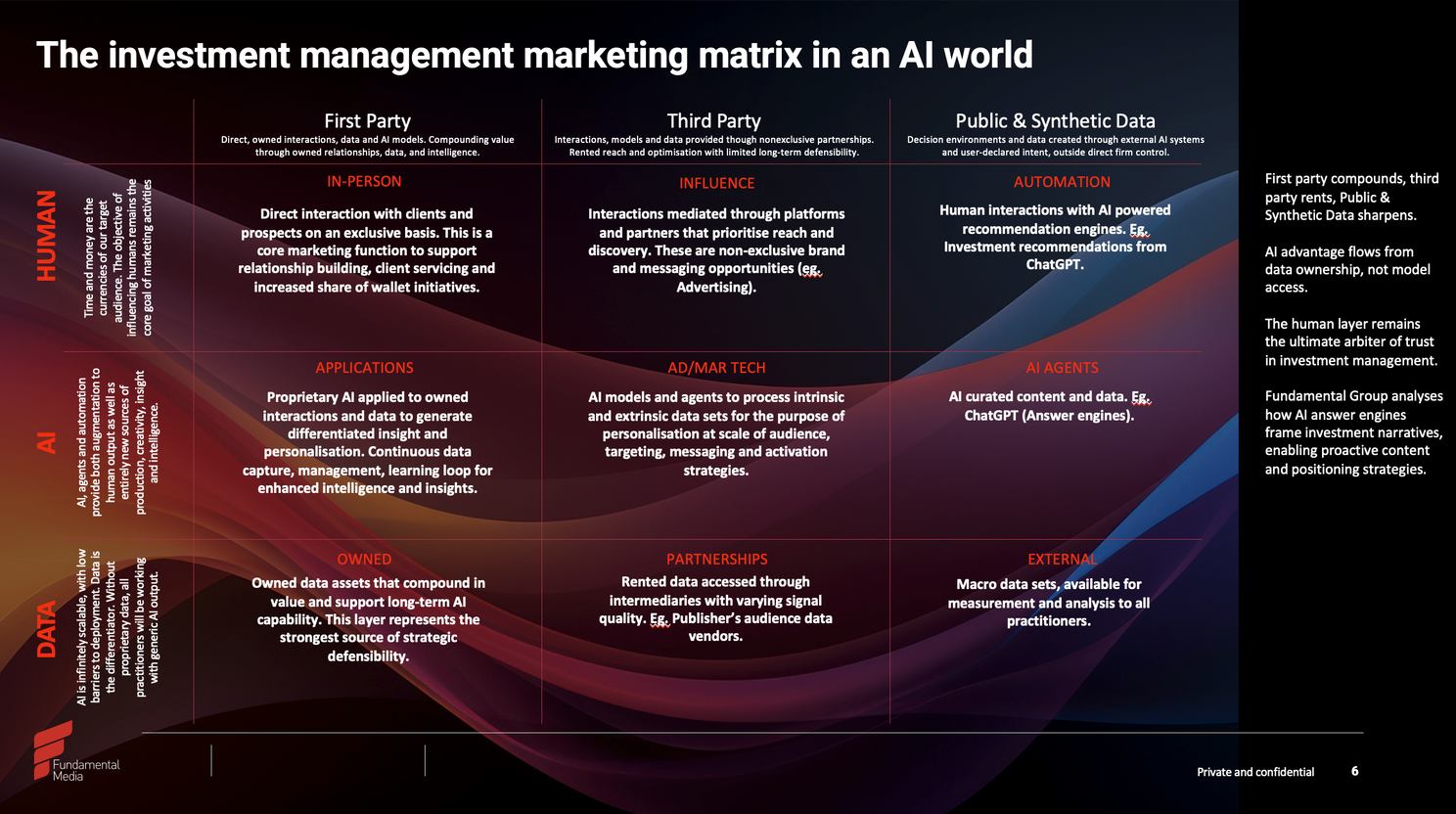
The investment management marketing matrix
One more dynamic most people miss, automation and amplification at the same time
AI is enabling two different things at once.
On one hand, it is automating process, drafting, reporting, QA, segmentation, and production workflows, which should give teams meaningful time back.
On the other hand, it is enabling entirely new solutions that previously sat in the “nice idea” category, agentic research loops, continuous optimisation, rapid productisation of internal tools, always-on analysis, and new distribution workflows. This second effect is the one that catches organisations out, because it creates an exponential increase in workload around assessment, approval, governance, and activation. The volume of outputs and deployable options rises faster than human review capacity.
In investment management marketing, where compliance and reputational risk are real constraints, the bottleneck will not be creation. It will be decisioning, control, and safe deployment.
The Architects
AI can build, but it cannot own the brief.
In this sector, the critical human role is the architect, the interface between client reality and machine execution. That means interpreting goals, constraints, and risk appetite, reading the nuance that never appears cleanly in a ticket or prompt, much of communication is non-verbal, contextual, and implicit.
The architect also has to translate strategy into a rigorous brief that AI agents can actually execute safely.
Accountability
AI does not carry accountability.
A mistyped prompt, a contaminated dataset, a broken dependency, the model does not care. You cannot persuade it, you cannot manage it like an employee, you monitor it.
More than once during this sprint I genuinely felt like I was being gaslit by a machine.
In regulated, reputation-sensitive work, clients will still want a human accountable owner, someone who is responsible for outcomes and for the behaviour of the systems producing them.
Reputation
Models can update, rebrand, or disappear. Humans cannot.
Reputation compounds, and in a world where output becomes cheap, reputation becomes more valuable. People who can take ownership, make decisions, and deliver will thrive. People who need constant instruction will be competing directly with machines.
What this means for investment management marketing
AI will not eliminate the need for specialist marketing, but it will compress the gap between idea and execution. The winners will be the firms who:
- Use AI aggressively for speed and iteration
- Protect trust with governance and security
- Invest in proprietary first-party and sector data that compounds
- Keep humans accountable for the brief, the constraints, and the outcomes
FM Group has been positioning for this for 15 years, building the data foundations and the operating discipline so that AI is a multiplier, not a liability.
What does this mean for us?
I do not see AI replacing people, but I do see AI replacing so many of the tasks that people perform. People will still be required to architect and be accountable for professional output. Human connection and trust will become more important. Proprietary data will be critical.
If you have not mapped your data strategy, and your governance strategy, for how AI will change distribution and marketing in investment management, you are already behind.