


Assemblers, architects, and the collapse of the formulation premium. Most of what we call knowledge work is formulation.
Not content production. Not information processing. Formulation — the act of applying individual knowledge to a specific context in order to turn messy reality into structured action.
A lawyer does not produce documents. A lawyer formulates: taking facts, constraints, and risk posture and converting them into an argument, a contract, or a compliance structure that commits real people to real consequences. A software architect does not write code. They formulate: converting a business goal into a set of design decisions that make the thing buildable. A strategist does not make decks. They formulate: converting an ambiguous situation into a plan that can survive contact with the organization.
Every knowledge profession, at its core, is a formulation profession. The artifacts are outputs. The formulation is the work.
And it is exactly this — the formulation premium — that AI is now attacking. Not uniformly. Not everywhere. But in ways that most people are not tracking, because they are looking at artifacts instead of the logic underneath them.
Assemblers and architects
Here is the split most people miss: Most of what gets sold as knowledgework, what gets paid for, is formulation.
But often, what feels like formulation to the person doing it, is actually assembly. It is the recombination of known patterns, known structures, known rhetorical moves, and known frameworks, applied to a recognizable situation. It is skilled work. It takes experience. But it operates on materials that already exist in recognizable form.
AI can do assembly. . . in fact, one could argue as I do, that it is pretty much the only thing that it does. The patterns are in the training data.
What AI cannot do reliably is architecture — the kind of formulation that requires reading the actual situation and building something that fits it, rather than fitting the situation to templates. Architecture demands three things AI does not have.
The first is contextualization. Not the generic version of the problem, but the real one — the politics nobody wrote down, the client's actual risk tolerance as opposed to their stated risk tolerance, the history of what has already been tried and why it failed.
The second is genuine novelty. AI recombines what has been done before. It cannot reliably create structures that do not yet exist in recognizable form, because it has no way to evaluate whether something truly new is good — only whether it resembles things that were.
The third is tacit knowledge detection. Recognizing what is not in the brief. The unstated assumptions. The unwritten rules. The things that would make the plan fail that nobody has surfaced yet. AI does not know what it does not know. An experienced architect does.
Assemblers operate on known patterns. Architects operate on real conditions. AI commoditizes the first. The second is where value concentrates.
The Architect – Assembler – Architect Loop
In practice, the two work together. Architects set constraints and direction. Assemblers — increasingly AI-assisted or AI-performed — generate within those constraints. Architects review the output against reality, catch what the assembly missed, and redirect.
That loop — architect, assembler, architect — is becoming the fundamental unit of knowledge work production. And it does not happen just once. Within any segment of a value chain, the loop may iterate multiple times as the formulation is tested and refined. Or it may happen sequentially, each cycle building on the last — a constructive process where every judgment pass adds a layer to the final output. A legal strategy is not formulated in a single pass. Neither is an organizational redesign, a software architecture, or a campaign. Each loop is additive. Each one requires the architect to bring real judgment to bear on what the last cycle produced.
Which means AI does not reduce the need for architect work. It accelerates the demand for it. When assembly happens at machine speed, the judgment layer has to move faster too. The architect becomes the bottleneck in a much faster cycle, and the organizations that cannot speed up their judgment layer will find that faster production just means faster error.
Two axes, four worlds
To see where this plays out, you need two dimensions.
AI substitutability of production. How much of the core output can AI generate in usable or near-usable form? Low means AI cannot really do the work. High means AI can produce something that ships, or that can be quickly brought to shippable form.
These two axes create four distinct worlds, each with different implications for assemblers and architects.
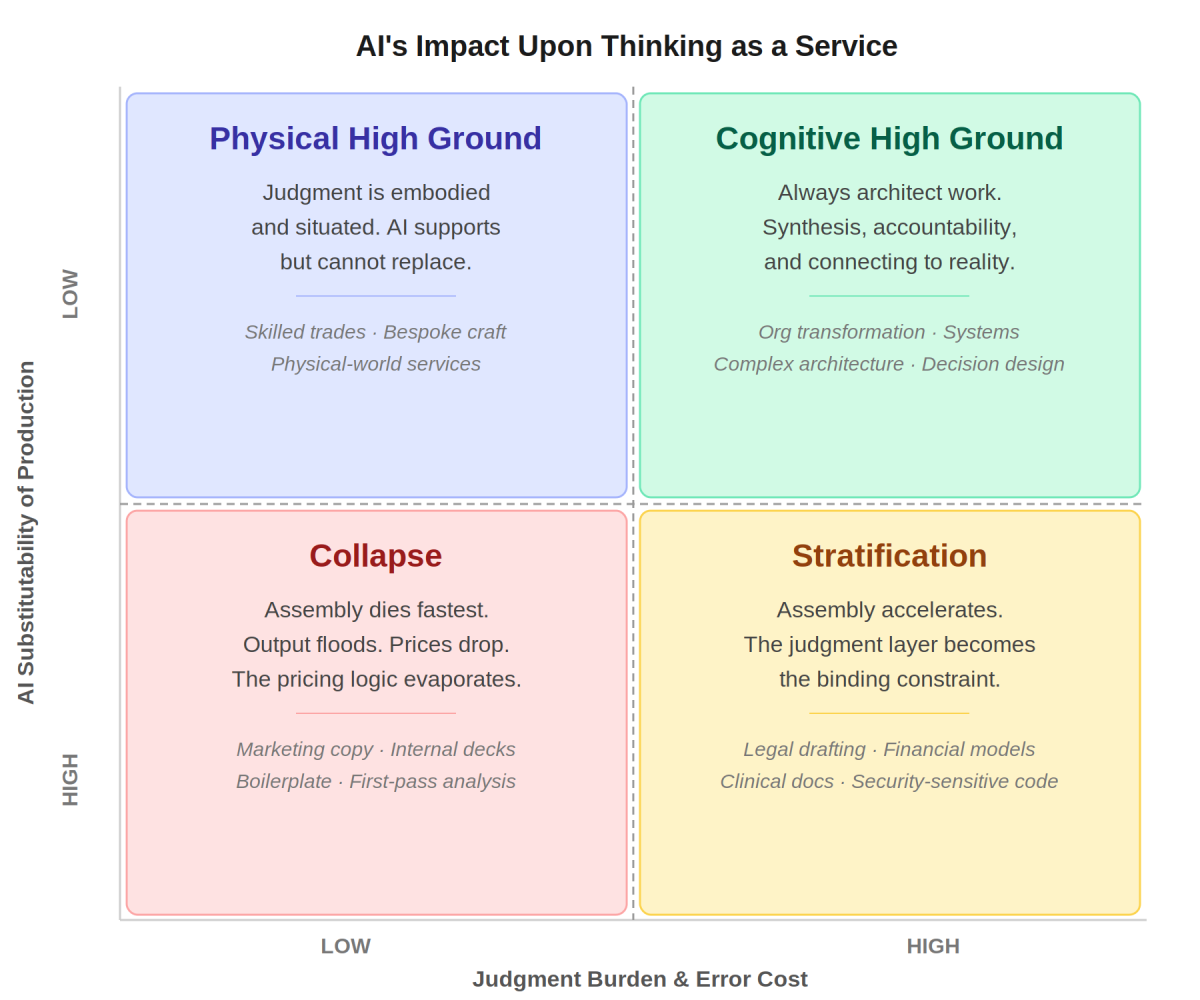
Assemblers, architects, and the collapse of the formulation premium
Most of what we call knowledge work is formulation.
Assemblers and architects
The Architect – Assembler – Architect Loop
Two axes, four worlds
To see where this plays out, you need two dimensions.
ardest commercial problem in the shift. Agencies cannot just "start selling judgment. " They have to reprice it from zero. They have to convince clients to pay for something those clients never knew they were receiving.
What does that look like in practice? It looks like an agency that gets paid to run a constraint-setting workshop before any creative begins — where the real brand boundaries, risk tolerances, and channel tradeoffs are made explicit, in writing, with sign-off. It looks like an agency that owns a defined review gate, with the authority to reject work that passes the AI plausibility test but fails the brand coherence test. It looks like an agency whose scope includes "we will tell you when your brief is wrong and show you why" — and that charges for that, rather than absorbing it as unpriced overhead.
That requires swimming upstream. The agency-client boundary has to move so the agency is involved earlier, in the problem definition itself, not just in the execution of a brief someone else wrote. The agencies that thrive will be the ones that reposition from "we make the thing" to "we own the thinking that makes the thing safe to make. "
Clients, meanwhile, will increasingly want a relationship that feels like speed and abundance. They will ask for "just one more version" because versions feel free now. The agency has to counter with a different promise: not more output, but better consequence control.
As output becomes abundant, clients will try to buy volume. Agencies will have to learn to sell consequence.
This is not unique to agencies. The same dynamic is disrupting every professional services value chain where AI makes production cheap — law firms, consultancies, software shops, architecture practices. Professional services may in fact be the most exposed category, precisely because they are formulation businesses by definition. The agency version just makes it visible first because the unbundling is already happening in real time.
What this means
Two things follow from all of this, and they apply to firms and to individuals alike.
The first is that the judgment layer is not shrinking. It is speeding up. When assembly happens at machine speed, architects do not get to slow-walk their decisions. The architect-assembler-architect loop is getting faster, and each pass still requires real judgment applied to real conditions. The organizations and professionals who can compress that loop without sacrificing the quality of judgment will pull ahead. The ones who cannot will produce more output, faster, with more embedded error — and they will not understand why things are getting worse.
The second is that the market is about to reprice the difference between assembly and architecture in every knowledge profession. For a long time, both were bundled together and paid for as one thing. AI is unbundling them. Assembly is heading toward commodity pricing. Architecture — real formulation, connected to reality, accountable for consequences — is heading toward scarcity pricing.
Every professional services firm, and every professional, now faces the same question: are you assembling, or are you architecting?
The market will not wait long for the answer.