


Key Takeaways
- Beneath the market volatility, leadership shifted toward tangible sectors tied to infrastructure, defense, and industrial buildout in the first quarter.
- The AI transition is as much about displacement as it is about innovation, with clear parallels to past structural disruptions.
- We believe current geopolitical events are reinforcing the shift toward tangible investment themes.
The first quarter of 2026 was so volatile that reviewing headline index performance sheds little light on economic fundamentals or market leadership. U.S. public equities declined by 3.9%[1]. Developed market (DM) equities fared little better, shrinking by a more modest 0.8%[2], underperforming their emerging markets (EM) brethren, which were flat[3]. Small caps outperformed large caps[4], and global fixed income slumped[5].
Heading into 2026, we expected the continued focus on gaining geostrategic autonomy—fueled by the proliferation of AI technologies—to power equity markets around the world. Our central thesis of “the revenge of the tangibles” focuses on next-generation defense, the electric tech stack, robotics, autonomous transport, and AI infrastructure buildout to drive economic growth and investment returns.
Investing in “the revenge of the tangibles” delivered outsized gains in the first quarter. Companies that derive at least 20% of their revenue from the abovementioned end-markets yield a universe of just under 2,000 names, which outperformed the broad MSCI All Country World Index (ACWI)[6] by more than 10% in the opening months of this year.
Relative Q1 Performance: Revenge of the Tangibles vs. MSCI ACWI IMI
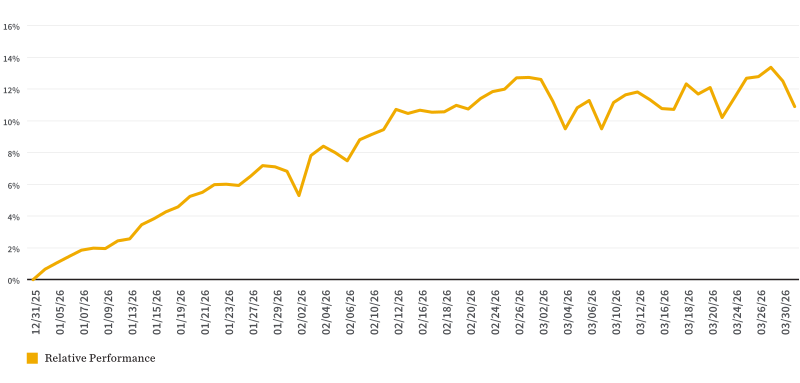
Source: Bloomberg, FactSet, and William Blair analysis, as of March 31, 2026. Relative performance measures the return of the “revenge of the tangibles” universe vs. the MSCI ACWI IMI over the same period.
Global Strength Meets AI Repricing
Global equities posted double-digit returns in the first two months of the year, while U.S. markets were busy digesting the implications of the unfolding AI rollout on existing software businesses.
For a decade, “capital-light good, capital-heavy bad” has been close to gospel: zero marginal cost, network effects, scaling laws, and high incremental margins. Some of this remains true, with new intangible models coming into view.
Yet the transition inevitably involves outright destruction, as many legacy software offerings were clunky, offering partial, often difficult-to-implement solutions. If AI removes some of these frictions, the associated products may no longer need to exist, or their price will be reduced to their marginal value.
In other words, AI has escaped the lab and is diffusing. We believe software companies must adopt and adapt and do so quickly and decisively.
While we expect a select group of incumbent software businesses may ultimately benefit from an expansion of their total addressable market (by leveraging their scale and competitive advantages to integrate AI and fight back against AI-native upstarts), nearly two decades of abundant capital and lofty valuations have fueled complacency and turned tailwinds into a sedative for many incumbents.
Furthermore, some companies are buying back stock with shareholders’ money, some are building “agents” to help with complexity within existing offerings, and many are sitting on the sidelines. A recent sell-side software analyst summed up the attitude of many software executives when he said, “This isn’t fair; it didn’t used to be like this.”
A Parallel from the Newspaper Era
While watching the current debate on software, we are reminded of the early 2000s debate over newspapers. Then, as now, stock prices moved well ahead of earnings downgrades: consensus forward estimates remained basically flat between 2002 and 2007, even as stock prices declined by 60%. But by 2011, earnings forecasts converged on stock prices, and both settled at about 10% of the 2002 average.
Management rhetoric then followed a familiar script.
- Reframe as cyclical, not structural: During the advertising slump in 2007 and 2008, Gary Pruitt, then-CEO of newspaper publisher The McClatchy Company, said that a “significant portion” of the current troubles the industry faced were “cyclical.” The company went on to file Chapter 11 bankruptcy in February 2020.
- Claim “hard-to-replicate moat”: Mike Reed, the CEO of GateHouse Media, which filed Chapter 11 in 2013, said in the company’s first quarter 2009 earnings release, “We view our exclusive local content as our greatest asset and as our sustainable competitive advantage.”
- Argue scale will fix it: Dennis J. FitzSimons, who was the CEO of Tribune Company in 2003, said at the time, “Tribune will be bigger and in the top tier of its core broadcasting and newspaper businesses 24 months from now, as scale will be increasingly important in a fragmented marketplace.” The company filed for Chapter 11 in December 2008.
- Emphasize current returns: Craig Dubow, who led Gannett Company before and during a restructuring between 2008 and 2010, said at the time the company’s core publishing business continued to generate significant cash flow even as print revenues declined. And Aaron Kushner, who became CEO of Freedom Communications after it filed for Chapter 11 in 2009, said that “We were profitable last year. … We will be profitable this year, profitable next year and profitable the following year.”
- Move from denial to anger to acceptance: Real-estate investor Sam Zell was quoted saying, “I’m sick and tired of listening to everyone talk about and commiserate over the end of newspapers. They ain’t ended and they’re not going to end. I think they have a great future,” after completing the $8.2 billion leveraged Tribune Company buyout. Soon after Tribune’s bankruptcy, however, Zell offered a mea culpa during an April 2009 Bloomberg Television interview. He said, “The definition if you bought something and it’s now worth a great deal less, is you made a mistake. And I’m more than willing to say that I made a mistake. I was too optimistic in terms of the newspaper’s ability to preserve its position.” Zell added that the newspaper model in its current form did not work and needed to be acknowledged as such.
The Impact of the Iran War
And then came the Iran war. Oil prices shot up 60% to 70% between the start of the conflict through March 31, 2026, depending on the exact grade of crude. The U.S. dollar firmed slightly, and U.S. equities outperformed their DM and EM brethren. The U.S. economy is an oil and gas exporter and as such is relatively insulated from the negative impact of scarce energy supplies.
The Iran war also interrupted the debate on software: between November 2025 and February 2026, software underperformed the S&P 500 Index[7] by 30%, but in March 2026, it performed in line with the broad index.
The latest military conflict in the Middle East has reinforced the case for accelerated defense spending by all those who can afford it, not to mention the rebuilding of U.S. military stockpiles.
And just as with prior episodes of high fossil energy prices, this one will accelerate the transition away from oil and gas. The more things change…
Related:
[1] The MSCI USA IMI is a broad equity index designed to represent the performance of the entire U.S. stock market across all size segments. [2] The MSCI World ex USA IMI is a broad global equity index that measures the performance of DMs outside the United States. [3] The MSCI Emerging Markets IMI is a broad equity index that tracks the performance of EM stocks across all company sizes. [4] The MSCI ACWI Small Cap Index measures the performance of small-cap stocks across both DMs and EMs worldwide. [5] The Bloomberg Global Aggregate Bond Index is a widely used benchmark for global investment-grade fixed-income markets. [6] The MSCI ACWI is a broad global stock market index that measures the performance of publicly traded equities across the world. [7] The S&P 500 Index is a stock market index that tracks the performance of 500 of the largest publicly traded companies in the United States.